
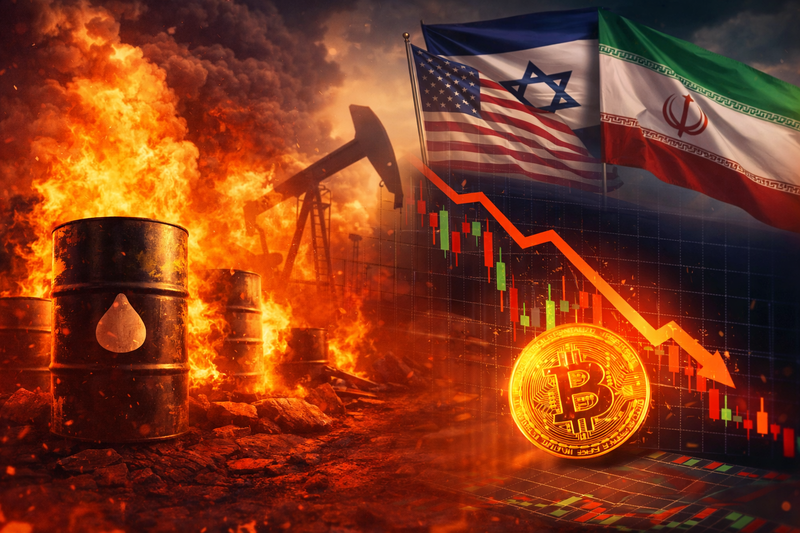
 ▲ Iran Warns Oil Could Reach $200… What Would Be the Impact on Bitcoin Prices?/ChatGPT-generated image |
Warnings that oil prices could surge to as high as $200 per barrel have prompted analysis suggesting that Bitcoin (BTC) could also experience significant volatility depending on geopolitical risks.
According to DL News on March 12 (local time), an Iranian military spokesperson warned that international oil prices could more than double if the United States and Israel continue the war. As the conflict shakes the global energy market, crude oil price volatility has increased, leading to expanding fluctuations in the cryptocurrency market, including Bitcoin.
Sebastián Serrano, CEO of Argentine cryptocurrency exchange Ripio, explained that rising energy prices could negatively affect Bitcoin’s price. He noted that higher energy costs increase inflationary pressure, which may delay central banks from cutting interest rates, ultimately reducing market liquidity and weakening Bitcoin’s upward momentum.
Recently, BTC experienced a sharp sell-off immediately after the United States and Israel launched attacks on Iran, followed by a rebound. According to CoinGecko data, BTC is currently trading around $70,000 and has maintained a relatively stable trend since the outbreak of the war on February 28. However, experts warn that volatility could expand again if geopolitical risks persist.
Some in the market also argue that Bitcoin has yet to fully perform its traditionally claimed role as a “safe-haven” asset. Laurens Fraussen, a research analyst at data analytics firm Kaiko, said that the narrative of Bitcoin as an inflation hedge has already weakened considerably.
He added that although the U.S. Commodity Futures Trading Commission (CFTC) classifies BTC as a commodity like gold or oil, in reality it tends to move more like a risk asset such as technology stocks. Over the past year, BTC has been highly sensitive to geopolitical shocks, and further escalation of tensions in the Middle East could lead to additional volatility alongside equity markets.
Disclaimer: This article is for investment reference only, and we are not responsible for any investment losses incurred based on it. The content should be interpreted for informational purposes only.
![[국제금융 브리핑] “유가 200달러 경고까지”…중동 전쟁 격화에 글로벌 금융시장 흔들](https://c-kill.com/wp-content/uploads/2026/03/aj2ndkuaci-y0xbsN-768x512.jpg)


![[DEX 리포트] DEX 트렌딩 1위 ‘Distorted’ 138% 급등](https://c-kill.com/wp-content/uploads/2026/03/7tsrqo4vgt-6Lo8le-768x478.jpg)
![[선물 고수 PICK] 도지코인 마진 비율 급등…이더리움 달러 마진은 큰 폭 하락](https://c-kill.com/wp-content/uploads/2026/03/l6yy2mf75g-qFErWk-768x461.jpg)
![[사설] 적은 알고, 나는 모른다 — 암호화폐 시장의 자기기만](https://c-kill.com/wp-content/uploads/2026/03/s3otqkv8gl-mtCLLZ-768x440.jpg)
![[BTC 사이클 트래커] 비트코인 상단 매물대에 또 막혀…6만6000~7만 달러 박스권 지속](https://c-kill.com/wp-content/uploads/2026/03/3vz1g4s6wu-ZG0HPG-768x543.png)

![[스테이킹 랭킹] 하이퍼리퀴드 스테이킹 시총 13% 급증…BNB 보상 규모는 33% 급감](https://c-kill.com/wp-content/uploads/2026/03/jhzu3x8e3l-6ooaov-768x360.jpg)
답글 남기기